
The product
One product for most of what the office repeats
Atlas is not a tool you add to a stack of tools. It is one product with a team of agents inside it, covering the recurring front office and back office work of a dental practice, and one place you talk to. You ask Atlas, and the right agent does the work.
What makes an agent useful
Four things, and most tools have one
A chat window is one of these. Atlas is built on all four, which is the difference between a thing that answers and a thing that finishes.
A second brain your agents actually use
Your SOPs, protocols, phone scripts, brand voice, and history live in one place, in plain portable files you own. Agents read from it and write back to it, so the practice works from one source of truth instead of five versions in five inboxes.
Memory, so it does not start over
Atlas remembers across tasks. Last month follow-up informs this month. You are not re-explaining the practice at the top of every conversation.
The ability to actually do the work
Drafting is not the job. Sending, filing, logging, and picking it back up next week is the job. Atlas closes the loop inside a controlled workspace.
Control you can see
Approval gates on anything that leaves the practice, spend caps, scoped access, a full audit log, and a kill switch on every agent.
Your second brain
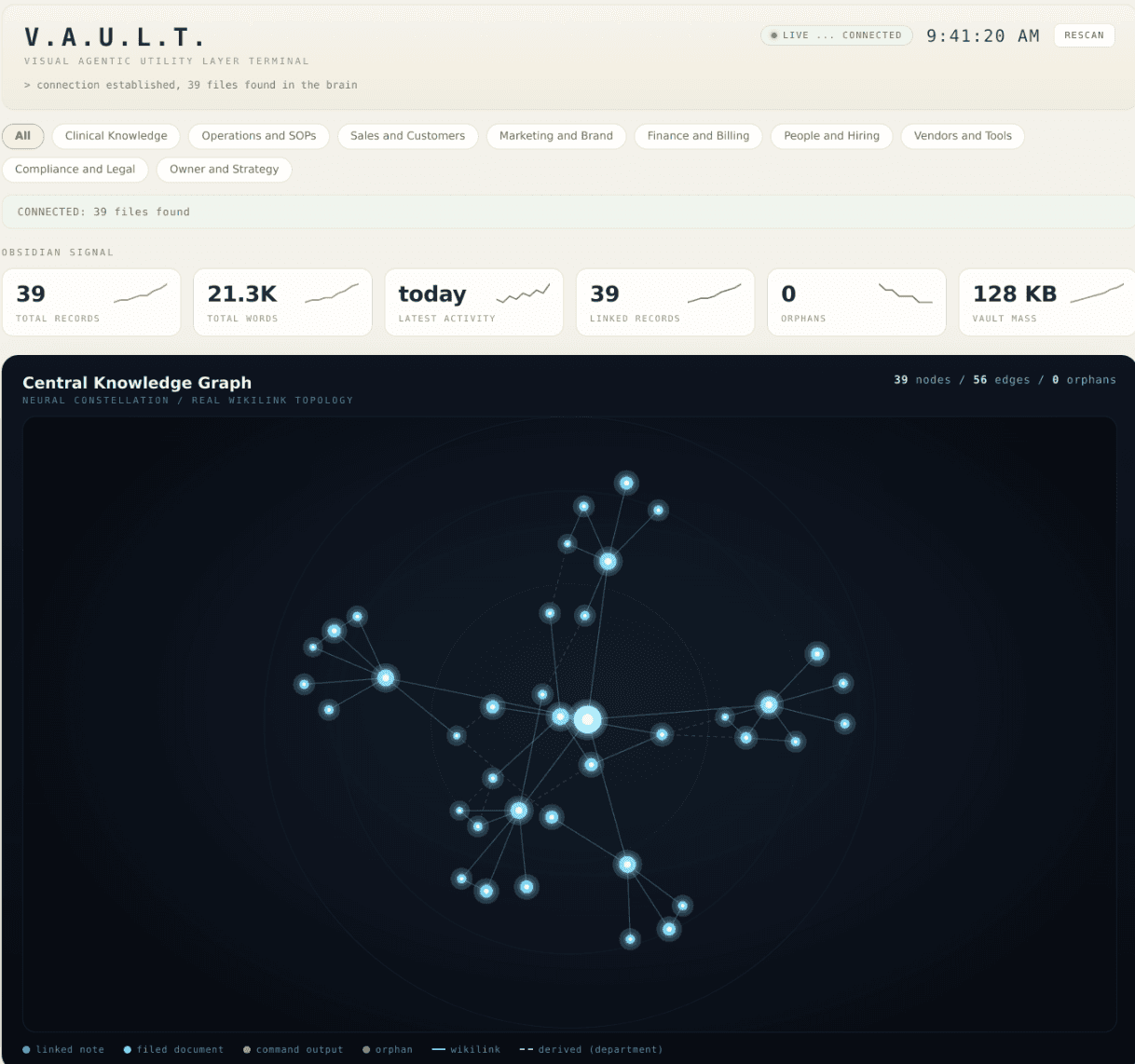
Everything the practice knows, in one map
Not a folder of documents. A living map of your protocols, scripts, notes, and files, and the connections between them, which is what lets an agent answer in your practice's voice instead of a generic one.
Underneath
What Atlas is built on
Atlas is the product and the thing you talk to. Underneath it are three open layers, integrated, secured, and maintained as one so you never have to touch them.
Obsidian and Hermes are trademarks of their respective owners. Atlas is independent and is not affiliated with or endorsed by them.
Control
Capable agents are only useful if you can stop them
Every control below is on by default. You loosen them deliberately, not by forgetting to tighten them.
Approvals
Nothing that reaches a patient, a payer, or a vendor goes without your say-so. You set which actions need a human and which do not.
Authority levels
Each agent runs at a level you choose, from observe only, to draft only, to act with your approval, to acting within limits you set.
Spend caps
Hard ceilings on anything that costs money, per agent and per practice.
Audit log
Every action, in plain language, with what was done and when. Not a debug trace, a record you can actually read.
Kill switch
Stop one agent or all of them, immediately.
Quality review
A dedicated agent reviews the others' work against the success criteria you set, and shows you the score.
Plans
Same product, two levels of information
Core gives you the whole team working from what you provide. Connect adds the practice management connection so the same team works from your real schedule, production, and ledger. No agent is held back to sell an upgrade.